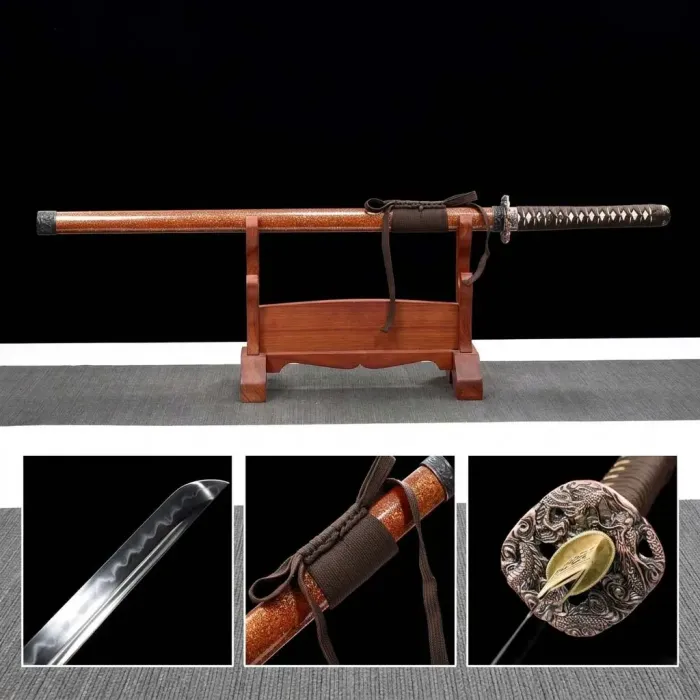
Every venerable ancient blade acts as a beautiful example of fabrication, but suppose you strive for to show your own style? Adjusting your gear is a rewarding journey, allowing you to fashion a truly distinctive piece. From the shaft wrapping and sheath to the shield design and temper line, each part offers a chance for personalization. This examination delves into the territory of katana modifications, providing guidance for both learners and seasoned enthusiasts pursuing to establish their mark on the traditional art of the samurai.
Freshman's True Artistry
For learners determined to embark on the rewarding journey of katana handling skills , 1060 steel katanas bring an excellent entry point. This certain grade of elemental steel finds a suitable blend between affordability and functionality . While inferior to hard as elite steels, 1060 provides a adequate level of sharpening , making it perfect for newcomers to develop the rudiments of sharpening care and respect the attractiveness of authentic Japanese weaponry. It’s a wonderful choice for developing experience without the budgetary burden of more sophisticated steels.
10# Steel Swords : Finding Quality and Affordability
For enthusiasts seeking an authentic cutting instrument experience without crossing the financial plan, T10 fabrication katanas represent a beneficial option. These daggers offer a marked improvement in endurance compared to less expensive alternatives, exhibiting good edge retention and sufficient flexibility for rudimentary slashing techniques. While not rivaling the eminent characteristics of elite steels like T100 or folded alloy , T10 provides a impressive blend of functionality and profitability, making them a sought-after choice for initiates and those on a tight income .
Going past the Keel : Tailoring Your Cutting Weapon's Fittings and Grasp
Whereas the sharpened blade is undeniably the key point of a katana, truly amplifying its aesthetic lies in the detailed customization of its components and grip . This approach allows users to showcase their special flair . Consider the ample possibilities: menuki - decorative charms that supply visual detail ; the hamon sheaths – often masterfully etched ; the tsuka foundation itself, wrapped in genuine ito string ; and the fusa knob , which can be designed from various resources like gold or tusk .
- Select designs that resonate with you.
- Explore with different ingredients .
- Prioritize superiority for a durable effect .
The Charm of the Katana: Heritage, Workmanship, and Metal
That traditional armament bears a unparalleled allure, steeped in centuries of the nation's history and folklore . More than merely a weapon of combat , it's a mark of the fighter class ethos – a fusion of artistry and governance . Its expansion spanned several generations, with early edges evolving into the sophisticated curvature and precise edge we recognize today. The creation involved is truly amazing , requiring eons of apprenticeship to perfect . The process involves a detailed folding of smelted iron , creating layers that augment the blade's flexibility and slicing ability. Diverse schools of crafting appeared , each with their special secrets and formulas for achieving the ideal equilibrium and edge - a truly strenuous pursuit.
- Primary Katana varieties
- The responsibility of the cutting armament in soldier culture
- Established processing practices
Identifying the Ideal Steel for Your Katana Project: 1060 vs. T10
Choosing the correct steel is critically important for any katana project, and the decision between 1060 and T10 can be tricky. 1060 is a popular American element, offering a competent balance of rigidity and endurance, supplying it reasonably easy to forge. However, T10, a East Asian steel, commonly boasts enhanced wear longevity and can possibly achieve a higher terminal hardness, although it can be substantially complex to operate and requires swords katana exact heat tempering. Consider your skillset and aimed features: for a inexperienced, 1060 may be a better entry, while the experienced smith might use the improved features of T10.
- Convenience of Working
- Longevity
- Decisive Rigidity
Opening the Possibilities: Elite Katana Enhancement Procedures
Honing the expertise in edge enhancement extends far beyond basic stropping. Serious professionals are now investigating advanced techniques to truly expose a blade's hidden potential. This comprises intricate work with the temper pattern, utilizing specialized compositions for differential strengthening and carefully choosing the outline of the protector to optimize balance and performance. Beyond purely functional refinements, artisans are increasingly focused on creating unparalleled aesthetic magnificence, through complex carving and layered varnishes that truly transform a katana into a showpiece.
Turning Raw Material into Excellence: Creating a 1060 Katana
The journey embarks with typical 1060 substance, a resilient material far lacking the elegant katana it will develop into. Expert bladesmiths execute a involved process of stacking and shaping the base steel, repeatedly tempering it and pounding it to rid impurities and create a steady grain structure. This arduous process, often enduring for stretches , builds the important toughness and malleability characteristic of a true Japanese weapon . Supplementary heat treatments , including exact hardening and curing , are critical to achieve the specific symmetry of sharpness, stability and elegance .- Stacking: Lowers impurities and establishes grain structure.
- Shaping: Designs the steel into the initial blade form.
- Curing: Directs the final hardness and flexibility.
The Continuing Pull of the Katana: Comprehensive Review of Metalwork and Tailoring
Each established katana stays a captivating symbol representing Japanese civilization , its magnetism far outstripping mere weaponry . Forged from a special steel and sometimes featuring intricate embellishments , the practice of creation itself is a esteemed art. Beyond the crucial craftsmanship, the ability to alter a katana - from the edge marking to the hold wrapping and fastening - provides for a wholeheartedly individual exhibition for both curators and practitioners alike. This combination of historical steelwork and boundless personalization contributes the katana's continued popularity across the universe.